Kitchen Remodeling Financing: How to Pay for Your Remodel
Compare kitchen remodeling financing options, from savings and credit cards to HELOCs and home equity loans, plus budgeting tips for Bay Area homes.

A major kitchen remodel now costs far more than many homeowners still have in their heads. Houzz's U.S. kitchen trends study put the median for a major kitchen remodel, defined as replacing at least all cabinets and appliances, at $55,000 for projects completed between mid-2022 and mid-2023. That was a 22% year-over-year increase, and nearly 60% above the $35,000 median recorded in mid-2020. National medians aren't San Jose bids. They do reset the question. Kitchen remodeling financing starts with a written scope and a borrowing target, not with a loan product chosen at the lender's desk.
Start With Scope and Set a Borrowing Target

A Bay Area kitchen project that replaces cabinets and counters but keeps the layout needs a different borrowing target from one that moves plumbing or removes a wall. Start by listing the work, then price each part: design, demolition, cabinets, countertops, appliances, electrical or plumbing changes, permits, and disposal. A written scope gives you a more useful estimate than a single round-number budget.
National cost benchmarks can help you compare the scale of different scopes. The figures below come from the 2025 U.S. Houzz & Home Study and its cited Cost vs. Value figures.
| Scope tier | Typical work | Reference cost | Estimated cost recouped | Financing fit |
|---|---|---|---|---|
| Overall median kitchen renovation | Mixed scope across projects | $22,000 | Not specified | Savings or a short credit-card balance |
| Minor mid-range | Refreshed finishes, no layout change | $28,458 | 113% | Savings or a fixed personal loan |
| Major remodel | Cabinets and appliances replaced, new counters | $55,000 median | Not specified | Home equity loan or HELOC, often blended |
| Major mid-range | Cabinets, counters, some utility or layout work | $82,793 | 51% | Lump sum or blended plan with verified scope |
| Upscale | High-end cabinetry, stone, structural and layout work | $164,104 | 36% | Cash-out refinance or blended plan with a larger reserve |
These are national reference points, not Bay Area bids. Cabinet quality, appliance grade, permit needs, and whether the kitchen is part of a whole-home remodel all affect the local estimate. Cost recouped is an estimate, too, not a promise of resale value.
Three scopes that change the loan
Countertop replacement. Keep the layout and replace the surface. Savings or a short-term loan may fit a contained project.
Cabinet and appliance replacement. Replace cabinets and appliances, add new counters, and leave the walls in place. This is a larger commitment that may call for home equity or a mix of cash and borrowing.
Moving a wall or relocating plumbing. Changes to the layout can add structural work, utility changes, and permit review. Before setting a borrowing target, review how to design a kitchen layout and account for the decisions that affect the final scope. Opening the kitchen to the living area may involve those added costs.
Build the target with a reserve
If the contract is $60,000, a 15% contingency adds $9,000, bringing the target to $69,000. Keep that reserve for issues such as concealed wiring, water damage, or an uneven subfloor, rather than upgrades added during construction.
Practical rule: Ask for an estimate that itemizes demolition, design and engineering, permit fees, electrical and plumbing changes, cabinets, counters, appliances, disposal, and a temporary kitchen setup.
9Builders' free Remodel ROI Calculator estimates how much value a remodel adds to a Bay Area home. Use that estimate alongside your written scope, then set a borrowing target that includes the contingency.
Seven Ways to Pay for a Kitchen Remodel Compared
Renovation funding varies with project size and payment method. In Houzz's 2024 renovation study, 84% of homeowners used savings, 29% used credit cards, and 12% used secured home loans. HELOCs funded 6% of projects. Cash-out refinancing and general home-equity loans each funded 3%. The figures describe renovation projects broadly, not kitchen-remodel loan recommendations. Choose a funding source by matching its repayment terms to the project's scope and payment schedule.
Rates, fees, and terms vary by lender and can change. Get a current written quote for each option you're considering.
| Funding option | Secured by home | How funds arrive | Best-fit project | Main risk |
|---|---|---|---|---|
| Savings | No | Immediately, from cash on hand | Deposits, permits, small updates | Draining the emergency reserve |
| Credit card | No | Charged as work is paid | A small purchase you can repay quickly | High interest if the balance lingers |
| Personal loan | No | Lump sum with fixed repayment | Fixed-scope projects with a known price | Rate depends on credit; no home collateral |
| HELOC | Yes | Drawn as needed during a draw period | Phased projects with an uncertain final cost | Variable rate; payments can rise |
| Home equity loan | Yes | Lump sum with fixed repayment | Fixed-scope major remodels | Interest starts on the full amount |
| Cash-out refinance | Yes | Lump sum that replaces the mortgage | Owners already refinancing or comparing rates | Closing costs and a reset loan term |
| Contractor-arranged financing | Only if the agreement creates a lien | Through the contractor's lender | Buyers who want one application | Verify rate, fees, and whether you sign the loan directly |
Trade-offs the table can't show
A credit card can cover a $2,400 disposal and range hood if you can clear the balance in one billing cycle. Carrying it through a multi-month remodel can make interest outweigh the convenience.
A HELOC suits uneven payments. Draw funds when a deposit or construction phase is due, rather than borrowing the full amount at the outset. Its variable rate means payments can rise.
A home equity loan provides one lump sum. Fixed repayment can make a defined project easier to budget, but interest accrues on the full amount even if some money sits unused until later.
A cash-out refinance replaces your existing mortgage. Compare the closing costs and new loan term with the cost of keeping your current mortgage and using a separate loan.
Contractor-arranged financing is a loan, not a price discount. Ask who the lender is, whether you sign directly with that lender, and what happens if work stops.
Matching Loan Draws to Each Construction Phase
Demolition comes first, followed by rough plumbing and electrical work, cabinet installation, countertop fabrication, and the final punch list. Payments follow those milestones, so the funding plan should match their timing and size. Keep an emergency reserve separate from money assigned to the project.
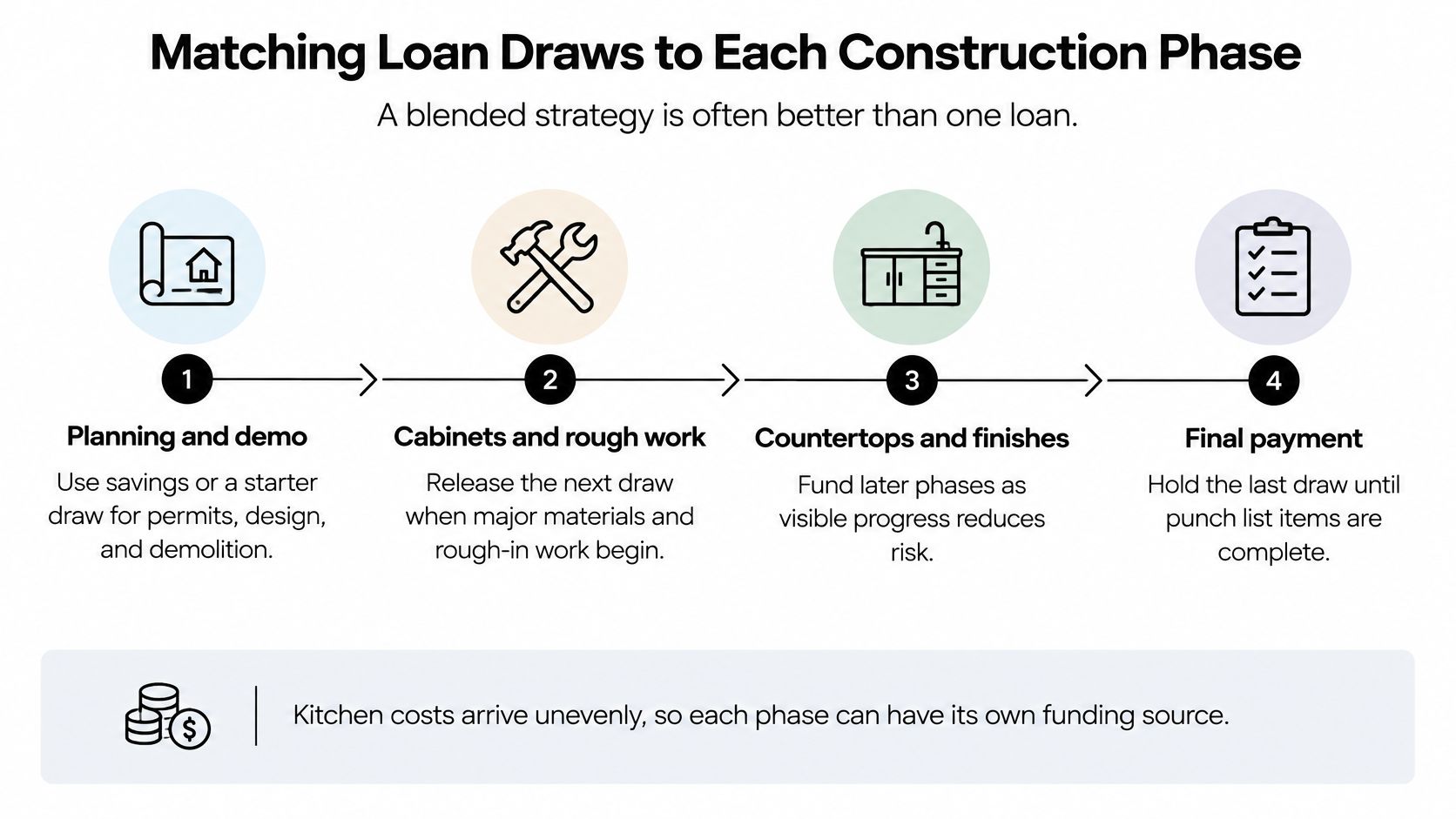
Kitchen expenses arrive at different points, sometimes weeks apart. Design and permit fees come before construction; cabinet deposits may be due well before installation. A funding source that suits one milestone may be a poor fit for another. The same timing matters when a kitchen project is combined with a bathroom remodel, home addition, or ADU.
A phase-by-phase assignment
Design, engineering, and permit fees. Use savings if available, and keep enough accessible for early costs. Drawings help define the scope before the remaining work is priced. Review the kitchen remodeling process and its milestones to align your budget with the project sequence.
Demolition, rough plumbing, and rough electrical. Savings or an initial HELOC draw may cover this phase. Hidden conditions can affect costs, so keep contingency funds available rather than committing them to finishes.
Cabinet deposit. Savings may cover the deposit; a credit card can work if you can pay the balance by the due date. Carrying a balance through a long cabinet lead time can add interest before installation begins.
Countertop templating and fabrication. Plan payment around templating and fabrication milestones. The template is made after the cabinets are installed, so confirm the payment dates with the contractor and fabricator.
Appliance purchase. Time a loan draw or card payment to the planned delivery. Buying well ahead of installation can leave appliances in storage while financing costs accrue.
Final installation and punch list. Keep the final payment tied to completion of the agreed work and any required inspection. Confirm the holdback amount and release conditions in the written contract.
Why the draw shape matters
Suppose $8,000 of a $60,000 project is due in the first month. A lump-sum home equity loan may charge interest on the full $60,000 from the start, while a HELOC generally charges interest on the amount drawn. The HELOC rate can vary, so payments may rise while the balance remains open. Compare the loan's draw rules, rate terms, and fees with the contractor's payment schedule before choosing.
Ask the contractor for a written draw schedule tied to project milestones. Compare it with the lender's release rules before signing either agreement.
What Borrowing Really Costs Over the Loan Term
A lower monthly payment can hide a much larger bill. The table below is an example only. It assumes a $40,000 balance at an assumed 8% fixed rate, fully funded at the start and repaid monthly. It is not a quote. It excludes origination and appraisal fees, annual charges, insurance, and any rate change.
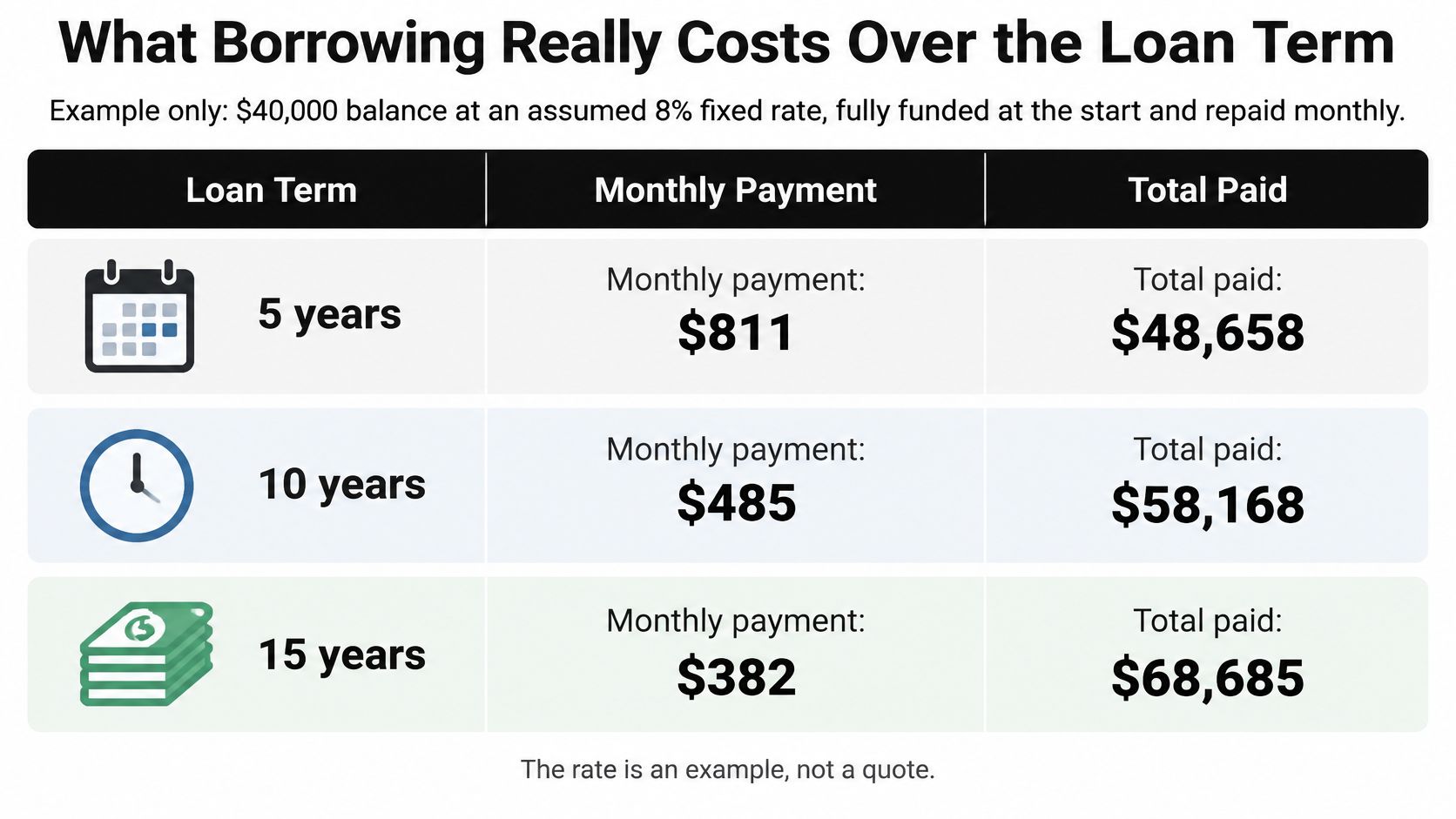
| Loan term | Monthly payment | Total paid | Interest paid |
|---|---|---|---|
| 5 years | $811 | $48,658 | $8,658 |
| 10 years | $485 | $58,168 | $18,168 |
| 15 years | $382 | $68,685 | $28,685 |
What the longer term is really buying
Stretching from 5 years to 15 years cuts the example payment from $811 to $382. Total interest more than triples, from $8,658 to $28,685. It's like a bigger cart that looks cheaper per trip and then takes far more trips to empty. If the payment only fits because the term is long, the project may be larger than the household can carry.
A fixed lump sum is predictable, and you may pay interest before the money is needed. A HELOC can limit interest to the drawn balance, and the rate on that balance commonly moves when benchmarks move. The payment can change while the loan is still open. Any loan secured by the house puts the house at risk if payments fail. The Federal Reserve reports that mortgage debt represents roughly three-fourths of total household debt. Secured borrowing is a different product from a personal loan or a card, even when the monthly number looks similar.
Five items to get in writing
- Total interest: Ask for interest over the full term at the rate in the offer, not a teaser.
- Fees: Origination, appraisal, annual charges, and any broker fee.
- Rate-reset rules: What index the HELOC follows, and how often it can change.
- Early-repayment terms: Whether paying the loan off after the kitchen is done triggers a fee.
- Payment after full draw: The payment once the planned balance is outstanding, not the payment on the first small draw.
For a Bay Area job, keep a contingency reserve beside that full-draw payment. Concealed conditions don't wait for a rate lock.
Tax Treatment, Records, and Common Mistakes
A home-equity loan or a HELOC isn't deductible just because the house secures it. IRS Publication 936 states that interest is generally deductible only when the funds buy, build, or substantially improve the same qualified home that secures the loan. A qualifying improvement must add value, prolong useful life, or adapt the home to a new use. Routine maintenance alone doesn't qualify.
What might qualify, and what might not
New wiring, relocated plumbing, or a layout change may fit better as a capital improvement than a standalone appliance swap. A kitchen modernization can qualify when it is part of a broader improvement. A repair by itself may not. The deduction generally requires itemizing, and it stays subject to mortgage-debt limits and to tax-law changes. Compare after-tax cost only after a tax professional checks your filing year and property type. Don't assume the interest comes off the return.
Records to keep before the first draw
- Signed construction contract: The scope the loan is supposed to fund.
- Invoices: Labor and materials, named to the kitchen, not mixed with unrelated house bills.
- Permit fees: City or county charges tied to this permit.
- Design and engineering costs: Drawings and structural work if a wall moves.
- Payment records: Checks, transfers, and card statements.
- A separate disbursement trail: Renovation spending that doesn't pass through the household grocery account.
Mistakes and the fix for each
Borrowing only the contract price. Add the contingency before you close. A reserve added later is a second application.
Carrying a card through a long build. Pay the card down when a draw arrives. A card is a bridge, not a construction loan.
Picking the longest term for the smallest payment. Put total interest next to the monthly number before you choose.
Opening a HELOC before the scope and draw schedule exist. Get the written schedule first, then size the line.
Assuming every home-secured dollar is deductible. Mixing equity money into routine repairs without records weakens the file. Keep the trail, and let a tax professional confirm the year.
Expecting the largest remodel to earn its cost back. The recovery drop on upscale work is steep. Have a lifestyle reason, not only a resale hope.
Interest treatment follows how you spent and documented the money, not the name printed on the loan.
Questions to Ask Your Contractor Before You Sign
Clear answers now can prevent financing surprises later. Ask for each answer in the contract or a written addendum, where you can refer to it if the scope or schedule changes.
- Does the estimate itemize the work? Check that each major part of the project has its own line, so you can see what the price covers and compare revisions.
- Is a contingency included, and what can it cover? Ask how unexpected conditions will be handled and whether you must approve using the reserve.
- Which permit path fits this scope? Replacing finishes may involve different requirements from moving walls, windows, doors, structural elements, or the service panel. Confirm the process with the local building department; requirements can vary by location. Most remodeling projects require permits. A kitchen or bathroom remodel usually takes 4 to 8 weeks, while a full home remodel can take 3 to 6 months. These are typical construction timelines, not guarantees.
- How are lien waivers handled? Ask which subcontractors and suppliers will provide them, when you will receive them, and how the documents relate to your payments. Lien waivers help document payment for work or materials and reduce uncertainty about unpaid bills.
- What happens if the lender requests an inspection or more documentation? Find out who schedules the inspection, who provides access, and who sends the lender the required paperwork. Agree on how delays in lender review will affect the project schedule.
- How are change orders priced and approved? Require written details, including the revised cost and schedule, before the added work begins.
- If financing is arranged through the contractor, who is the lender? Ask whether you sign the loan directly with that lender and request the rate, fees, and repayment terms in writing.
- Who pulls permits and schedules the final inspection? If the kitchen is part of a whole-house remodeling project, clarify who coordinates each inspection and what happens if corrections are required.
Permit approval is not guaranteed. Incomplete plans, concealed conditions, or agency comments can add time and cost, so ask how the contractor will communicate changes to the scope and schedule.
Choose a Funding Path and Confirm It With Your Contractor
The right funding method depends on what the remodel will cost, when payments are due, and how much uncertainty the project still holds. Choose the path that matches the scope you can price today, then keep the payment schedule aligned with the work.
For a smaller project, savings can cover the cost while leaving a reserve untouched. A credit card may suit minor purchases only if you can pay the balance quickly. For a defined scope with a written price, compare a fixed-rate personal loan with a home equity loan. A HELOC may suit work that unfolds in phases, but its rate and payment can change. For a layout change tied to a larger home plan, compare borrowing costs against the full project estimate, including contingency.

Use one final decision rule: choose the least flexible loan that still fits the project's uncertainty. A fixed price and stable schedule may support predictable payments; unresolved scope or phased work may call for access to funds over time. The trade-off is cost certainty versus flexibility, so keep the reserve separate from money needed for scheduled draws.
9Builders, a San Jose remodeling and ADU construction company, guides clients through home equity loans, HELOCs, construction loans, and California-specific ADU financing programs, and partners with lenders specializing in home improvement projects. Its guidance can help you understand possible funding paths, while the lender's written terms determine the actual rate, fees, and repayment obligations.
9Builders helps San Jose and Bay Area homeowners plan kitchen remodeling financing alongside design, permits, construction, and final inspections for kitchens, baths, additions, and ADUs. Bring your property details, project goals, and budget range to discuss which funding path may fit the project phases. Visit 9Builders to talk through your plans.